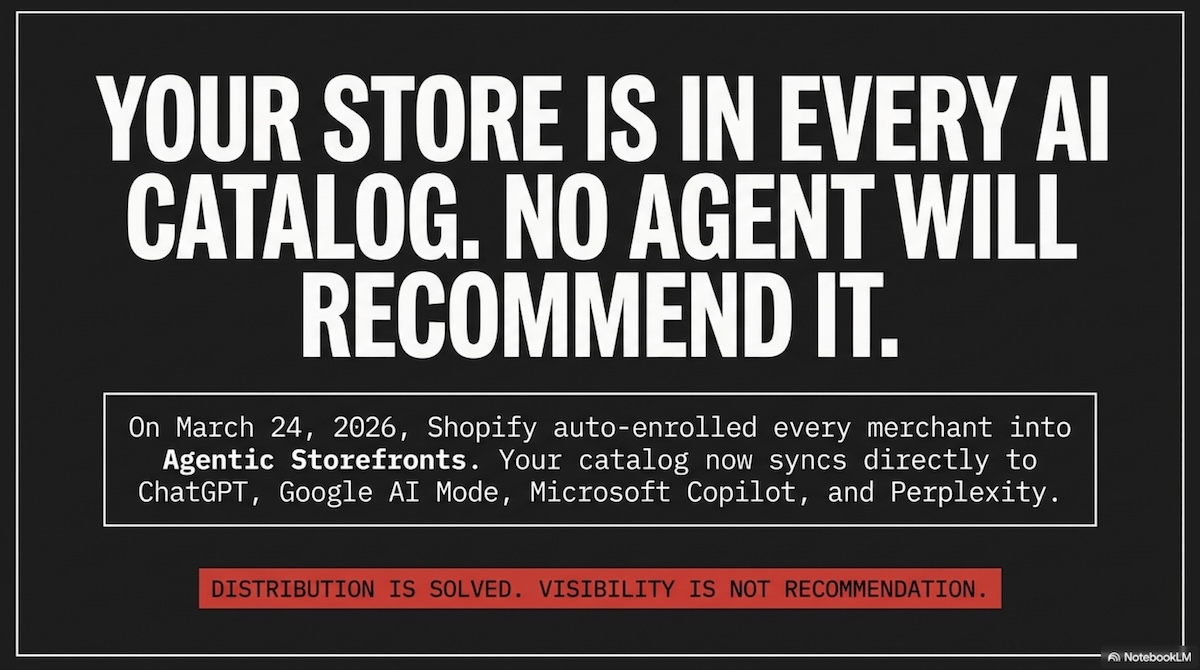
On March 24, 2026, Shopify auto-enrolled every merchant into Agentic Storefronts. Your catalog now syncs directly to ChatGPT, Google AI Mode, Microsoft Copilot, and Perplexity.
Distribution is solved. Every store reaches every AI shopping platform.
But visibility is not recommendation. In our 1,000-store benchmark, the average Shopify store scores 42 out of 100 on Inference Advantage — the measure of whether an AI agent has enough structured data to recommend your products over a competitor's. You're on the shelf. The agent won't pick you.
The 30-Point Gap
The recommendation threshold sits at 72 out of 100. The average is 42. That gap determines whether an AI agent includes your product in a response or skips it entirely.
We scored 1,000 Shopify stores across six verticals. Named results:
- Wild One: 79 — complete GTIN coverage, category metafields, review schema
- Honest Paws: 78 — FAQ coverage, functional descriptions, trust signals
- Allbirds: 49 — zero structured data despite global brand recognition
- Gymshark: 41 — zero structured data, zero review schema
- MVMT: 15 — severe gaps across all four scoring dimensions
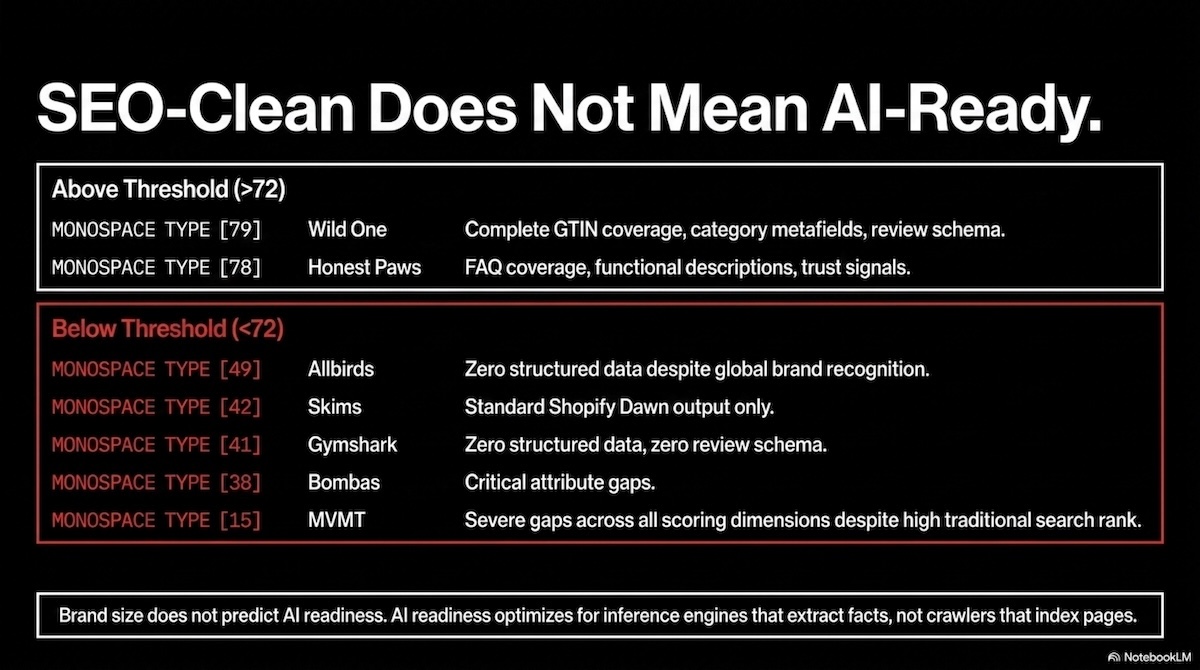
Allbirds and Gymshark are household names. Neither clears the recommendation threshold. Brand size does not predict AI readiness. SEO-clean does not mean AI-ready.
Why Agents Skip Your Products
AI shopping agents decompose queries into sub-questions. When someone asks Google AI Mode for "waterproof running shoes for winter," the agent evaluates: waterproof rating, traction type, temperature range, breathability, and sizing — simultaneously.
Your product gets recommended only when the agent finds structured data answering every sub-question with confidence. Marketing language fails this. "Ultimate winter performance" returns nothing parseable. "IPX4 water resistance, Vibram Arctic Grip outsole, rated to negative 10 degrees Fahrenheit" wins.
Shopify's Dawn theme outputs basic Product JSON-LD: name, price, availability, image. It skips the fields agents need most:
- aggregateRating — requires review app integration
- GTIN/MPN — requires metafield mapping
- Material, color, size as Product-level properties
- Google Product Category path
- Shipping details and return policy in structured data
- Category-specific attributes — requires taxonomy assignment
Without these, agents see a generic Product object. They cannot compare it, verify it, or recommend it.
Three Fixes. No Developer. Twenty Minutes.
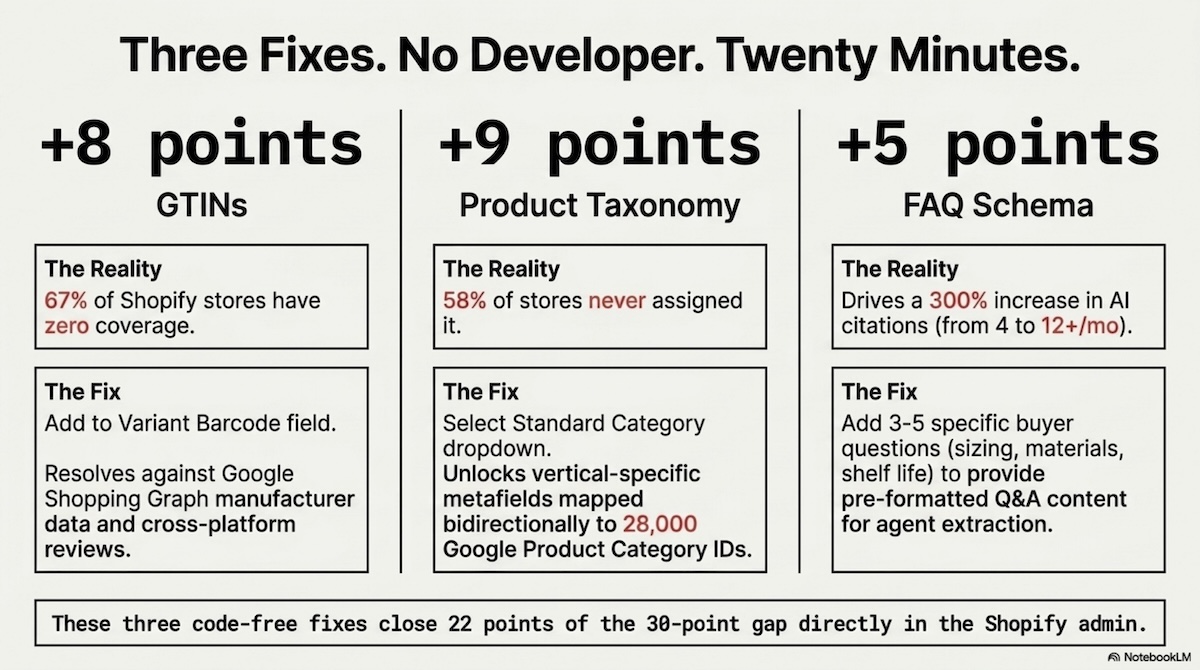
These three changes close the gap between 42 and 72. Each is validated against how Google, ChatGPT, and Copilot evaluate products.
Add GTINs to your variants: +8 points
Google's Shopping Graph uses GTIN as a primary entity key. Without it, your product cannot be resolved against manufacturer data, cross-platform reviews, or price comparisons. Among stores in our benchmark, 67 percent have zero GTIN coverage.
In Shopify admin: Products, then Variants, then the Barcode field. Bulk upload via CSV for larger catalogs.
Assign Shopify Product Taxonomy: +9 points
Selecting a Standard Product Taxonomy category unlocks structured metafields specific to your vertical. Pet supplies gain compatible_species, life_stage, flavor. Apparel gains material, size_system, care_instructions. Shopify maps these bidirectionally to Google Product Category IDs across 28,000 leaf categories.
In our benchmark, 58 percent of stores never assigned taxonomy. Zero category metafields means zero structured attributes for agent comparison.
One dropdown selection. Immediate attribute layer.
Add FAQ schema: +5 points
Stores with product-level FAQ schema see a 300 percent increase in AI citations, from roughly 4 per month to 12 or more. FAQ pairs give agents pre-formatted question-and-answer content they extract and cite directly.
Write three to five buyer questions per product: sizing, materials, compatibility, shelf life. Not marketing questions. Buyer questions.
The Revenue at Stake
AI referral traffic grew 693 percent year-over-year between November and December 2025, per Adobe's holiday commerce report. Conversion from AI referrals runs 31 percent higher than traditional search traffic. Revenue per visit from AI referrals increased 254 percent year-over-year in the same period.
Shopify's own data shows agentic traffic increased 15 times between January 2025 and January 2026. Stores with dual UCP and MCP protocol coverage see 40 percent more agentic traffic than single-protocol stores.
Amazon's Rufus handled 300 million users in 2025, driving 12 billion dollars in annualized sales with a 60 percent conversion lift over traditional Amazon search, per Amazon's Q3 2025 earnings.
Most merchants cannot see this traffic. GA4 captures only 9 percent of Gemini iOS visits. ChatGPT mobile does not preserve referrers. Merchants measuring AI impact with standard analytics see a fraction of reality.
Proof: 37 to 100 in Seven Phases
CogniPaws entered our benchmark scoring 37 out of 100. Solo founder, three products, zero developer resources.
Seven optimization phases. Each fix was copy-paste in Shopify admin. Final score: 100 out of 100 — outperforming Allbirds (49), Gymshark (41), Skims (42), Bombas (38), and MVMT (15).
The last five points required discovering platform-level issues invisible to merchants: a robots.txt configuration blocking an AI search crawler, missing OpenGraph product metadata, and JSON-LD validation errors only visible to automated parsers.
The barrier is not technical skill. It is knowing which fixes matter most.
What to Do Now
- Score your store. Run your Inference Advantage assessment to see exactly where you fall across the 18-check rubric.
- Fix the top three. GTINs, taxonomy, FAQ schema. Twenty minutes for 22 points of recovery.
- Rescan. Verify the fixes registered and check remaining gaps.
The 30-point gap between average and top quartile is the distance between invisible and recommended. Merchants closing it now capture disproportionate share of the fastest-growing commerce channel ever measured.
Your store is in the catalog. Make the agent pick it.
FAQ
If Shopify enrolled me automatically, why isn't that enough?
Catalog inclusion means AI agents can see your inventory. Recommendation requires structured data above the agent's confidence threshold. The average store scores 42 out of 100. The threshold is 72. Presence is not preference.
How long do these three fixes take?
Fifteen to thirty minutes for a small catalog. CogniPaws completed all seven phases with zero developer involvement. GTINs go in the barcode field. Taxonomy is a dropdown. FAQ is a metafield or description block.
How do I measure if AI agents recommend my products?
Standard analytics miss most AI referral traffic — GA4 captures 9 percent of Gemini iOS visits. Track your Inference Advantage Score weekly to measure structured data improvement. For traffic attribution, you need AI-specific referral tracking beyond GA4.
Is this different from SEO?
Yes. SEO optimizes for crawlers that index pages. AI readiness optimizes for inference engines that extract facts and make purchase decisions. MVMT ranks well in traditional search and scores 15 out of 100 for AI readiness. Different problem, different optimization.
What if I already have good reviews and fast shipping?
Those matter — but only if they're in structured data. Reviews in a third-party widget that doesn't emit aggregateRating JSON-LD are invisible to agents. Shipping speed that lives only on a policy page doesn't populate OfferShippingDetails schema. The data has to be machine-extractable, not just human-readable.