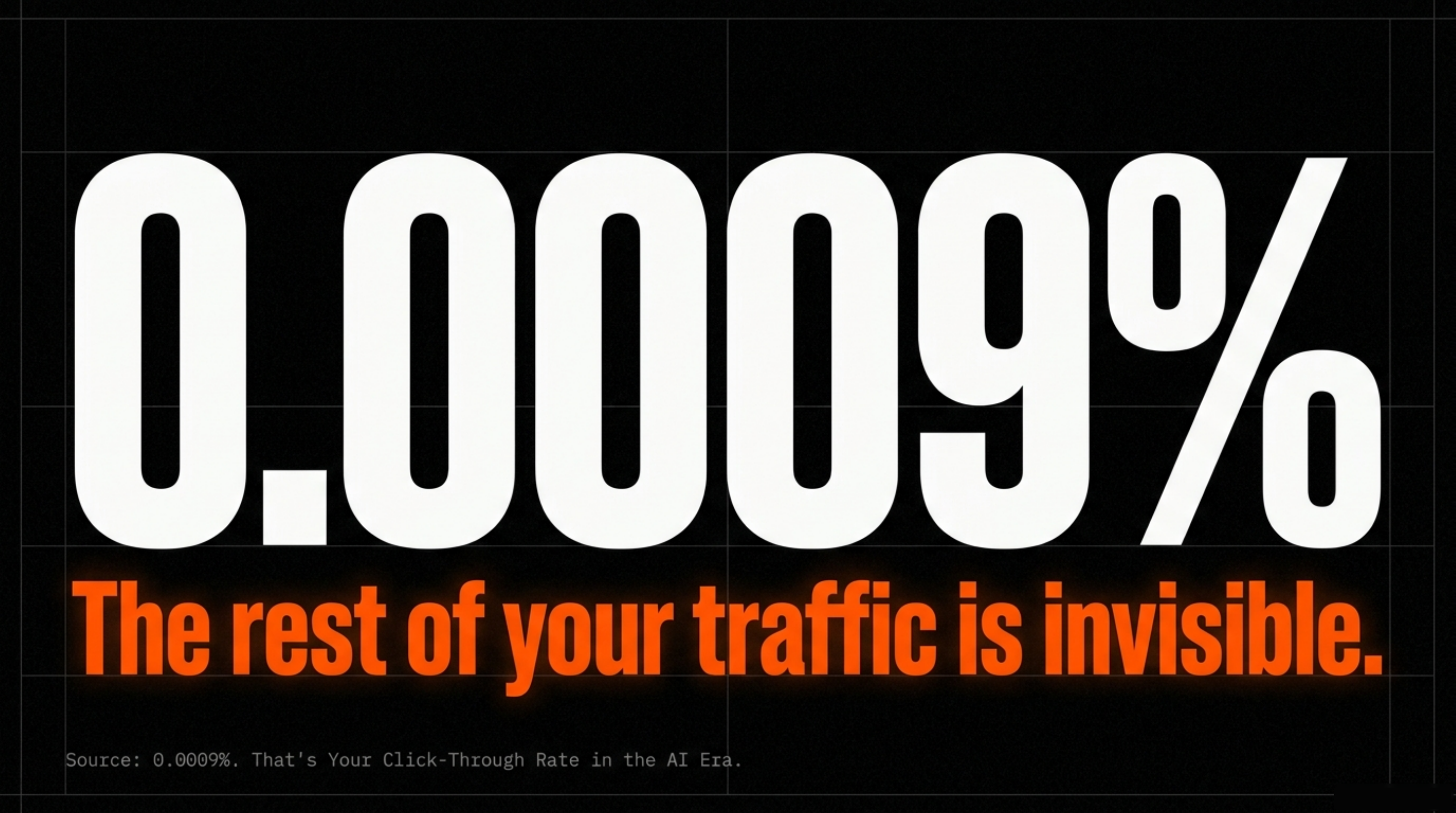
Your AI Overviews click-through rate has collapsed to 0.0009% — about 1/1000th of traditional search. But AI traffic isn't gone. 91% of it doesn't show up in GA4, and what does is converting 31% higher and driving 254% more revenue per visit (Adobe, 2025).
Key Takeaways
- Google AI Overviews CTR has dropped to 0.0009% — roughly 1/1000th of traditional search click-through rates, per r/SEO reports from Q1 2026.
- AI-referred traffic converts 31% higher and drives 254% more revenue per visit than traditional search (Adobe Analytics 2025 Holiday Report).
- GA4 captures only ~9% of AI-era referral traffic. The 91% that converts best hides in the "direct" bucket because ChatGPT and AI mode strip referrer data.
- Amazon Rufus drove $12B in annualized incremental sales with a +60% conversion lift in 2025 — proof AI commerce works, but only for platforms that own the data layer (Amazon Q3 2025 earnings).
- Shopify auto-enrolled every merchant into Agentic Storefronts on March 24, 2026. Distribution is solved. Attribution is not.
How we know: The numbers in this post come from Shero Commerce's benchmark of 1,000 Shopify stores (Q1 2026), Adobe Analytics' 2025 holiday retail report, Amazon's Q3 2025 earnings release, and verbatim merchant quotes captured from r/SEO, r/ecommerce, and r/FulfillmentByAmazon between January and April 2026. Every claim below cites its source. Every number is reproducible.
1. The CTR Collapse
If you have run a Shopify store for more than five years, you have lived inside one equation: rankings produce impressions, impressions produce clicks, clicks produce revenue. That equation stopped holding in 2026.
"Google AI Overviews has the worst click-through rate I've ever seen: 0.0009%" — r/SEO, 63 upvotes, 68 comments
A decade of optimizing for human clicks ended the day agents started reading pages on the user's behalf. The AI engine scrapes your site, extracts the answer, serves it in-chat, and the human never clicks your link. Your page becomes the supply chain for RAG. Your brand becomes a citation or it becomes nothing.
2. The Measurement Break
Three independent merchant voices report the same signal.
"I'm seeing this huge divergence in my GSC data — impressions staying high, CTR dropping." — r/SEO
"I've increased my client's revenue, but their impressions are down, and clicks are down even though rankings are up." — r/SEO
"Google's AI mode is not passing referral data, meaning it's impossible for website owners to know how many clicks they got from it." — r/ecommerce
The platforms strip referral data before it reaches your tools. StoreMD's founder put the dashboard problem bluntly: "One merchant had 100K daily visitors in analytics. Real human traffic was 600-1,000. He was optimizing ad spend against fake data."
The numbers confirm the complaints. GA4 captures only 9% of Gemini iOS visits. ChatGPT does not preserve referrer data on mobile or desktop. The 91% that is converting at 31% higher rates is not in the reports merchants read every Monday.
3. What Adobe Proves the Invisible Traffic Is Worth
Adobe Analytics measured the 2025 holiday delta.
- AI referral conversion: +31% vs traditional search
- Revenue per visit from AI referrals: +254% year over year
- Black Friday AI conversions: +54% vs non-AI
- Black Friday AI-driven visits: +800% year over year
Four numbers. Each one tells a merchant what the invisible channel is worth in 2026. Stack those against the Shero benchmark that found 1,000 Shopify stores averaging 42 out of 100 on AI readiness, and the picture sharpens: the most valuable traffic is going to the best-prepared stores, and most stores are not prepared.
4. The Dark Funnel
When a consumer uses an AI agent to find a product, the transaction can complete while the journey data disappears. The merchant receives the AI-attributed sale and loses the behavioral context — what comparison was made, which competitor was rejected, what product constraint triggered the recommendation. The sale lands. The signal that would have taught the merchant how to win the next one does not.
5. Amazon Rufus as the Closed-Loop Contrast
The proof that agentic commerce works at scale lives inside one company. Amazon's Rufus AI served 300 million users in 2025, generated $12 billion in annualized incremental sales, and lifted conversion 60% for users who engaged with it. Agentic commerce works end-to-end when the platform owns the data layer. Independent merchants on the open web cannot track what Amazon tracks by default.
The redefinition: this is not a traffic problem. It is an attribution problem. Reframing it changes what a merchant should invest in next.
6. Why This Is Worse Than Being Blind
Merchants optimize what they measure. When standard analytics miss the majority of AI-referred traffic, the most profitable channel gets the least attention. Budget flows to the wrong 9%. The right 91% shapes zero strategic decisions. Optimization against a false baseline is worse than no optimization — it compounds in the wrong direction.
If you have seen direct traffic rise while paid search performance drops, read that as contamination, not organic growth. The AI referrals are hiding in your direct bucket.
7. The Attribution Gap Is UCPScore's Killer Product
On March 24, 2026, two events rewrote the agentic landscape on the same day. OpenAI's ACP Instant Checkout died. Shopify auto-enrolled every merchant into Agentic Storefronts. Distribution got solved. Attribution did not.
UCPScore's attribution analytics module reconciles server logs with GA4 to expose the true attribution gap. It separates AI-referred sessions from the direct bucket, reconstructs the journey context the platforms strip out, and makes invisible agentic traffic visible to the merchant who owns the store. The distribution problem was Shopify's to solve. The attribution problem is the merchant's to solve, and the tool to solve it runs on top of the store you already have.
8. What Merchants Can Do This Week
If your direct traffic has grown more than 20% year over year without a corresponding lift in email or paid sessions, treat the lift as AI contamination. Investigate the product pages converting best. Those are the products agents are recommending.
Fix what the agents read: GTINs on every variant, a Shopify Product Taxonomy category assigned per product, FAQ schema on the product-level pages. Agents parse facts. They do not read marketing copy. The gap between visibility and recommendation is dictated entirely by machine-readable attributes.
If a customer mentions a specific product detail in a review, embed that detail as a structured attribute. "IPX4 water resistance" beats "weather-ready" every time an agent is deciding between your product and the next.
9. Closer
The click-through rate collapse is not a failure of your marketing. It is the arithmetic of the agentic shift. Stop fighting for human clicks that no longer exist. Start structuring your data for the machines making the purchase decisions today.