Key Takeaways
How we know
The numbers in this post come from five primary sources.
The UK Competition and Markets Authority's March 9, 2026 guidance on AI agents and consumer law, analyzed by Cooley (March 26) and Pinsent Masons' David Tilbury (April 17). FINRA's 2026 Annual Regulatory Oversight Report (December 9, 2025) — the first standalone GenAI section in the report's history. American Express's Agentic Commerce Experiences developer kit launch (April 14), covered by Digital Commerce 360 with direct quotes from Luke Gebb, EVP of Global Innovation. Mastercard's Verifiable Intent open-source release (March 5) and its three-layer SD-JWT credential chain, documented by Fintech Wrap Up (March 15). And the Quad/Harris Poll on AI shopping trust, fieldwork April 13, 2026, n = 2,180 US adults.
Baseline context: Shopify auto-enrolled eligible stores into Agentic Storefronts on March 24, 2026. Every claim in this post assumes that starting condition and builds on the Intelligence Desk's earlier coverage of the rollout and its opt-out gap.
1. American Express just made a promise no payment network has ever made.
If you run a Shopify store, you did not opt into agentic commerce. Shopify opted you in. On March 24, 2026, every eligible store was auto-enrolled into Agentic Storefronts — meaning every Shop Pay transaction is now a surface an AI agent can initiate on behalf of a cardmember you have never spoken to, for a product your team has never described to them.
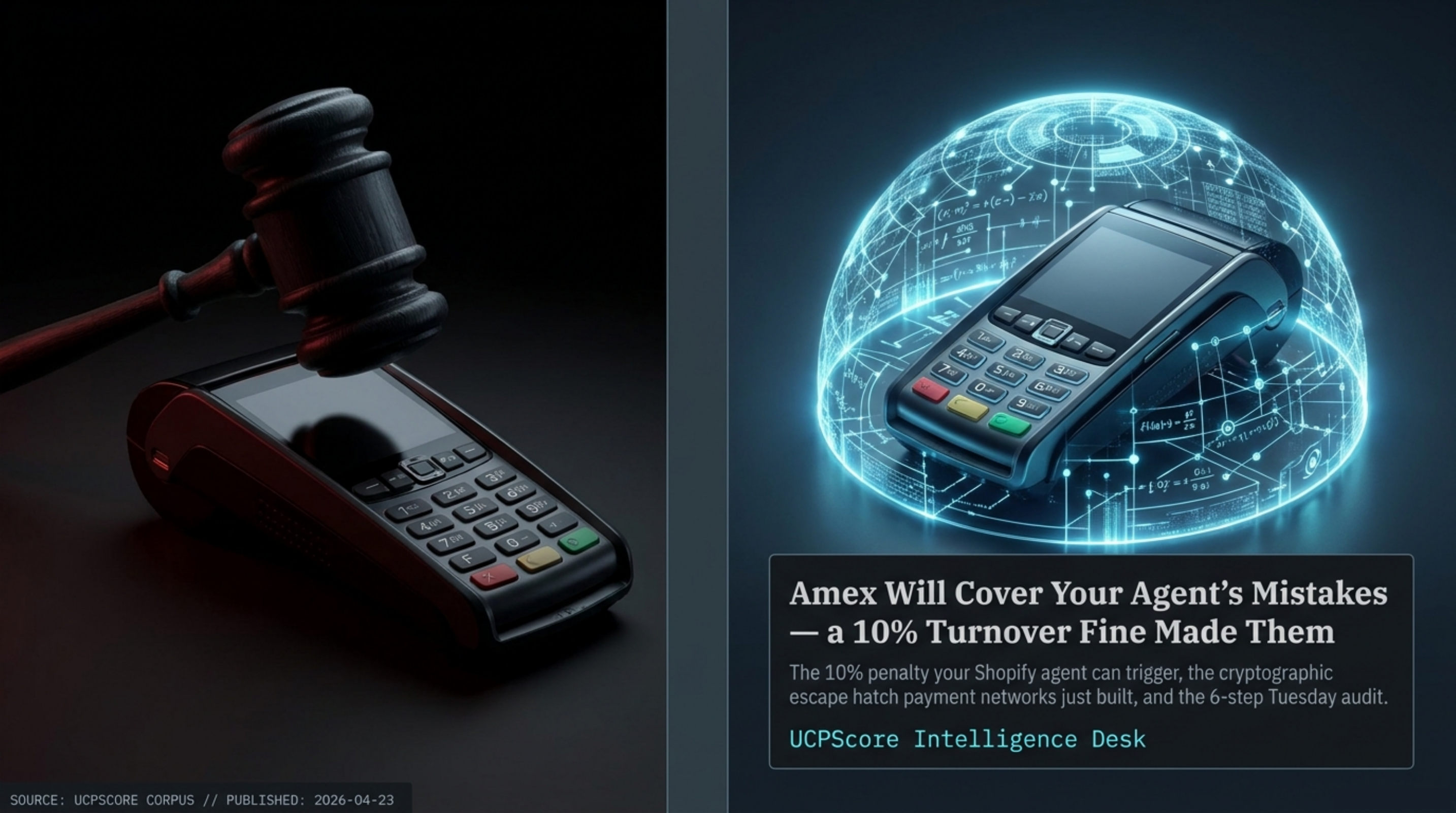
Three weeks later, on April 14, 2026, American Express's EVP of Global Innovation Luke Gebb made the announcement that lets that opt-in survive its first dispute. He called it Agentic Commerce Experiences — ACE — a five-component developer kit with one guarantee no payment network had shipped before. When a cardmember tells a registered AI agent to shop for green shoes and the agent buys red ones, American Express stands behind the transaction.
Gebb called it "an industry-first commitment." The catch is three gates. The agent must be registered through the ACE developer kit. The cardmember must have enrolled their card with that specific agent. Amex must receive the cryptographically signed intent before the purchase fires. When all three close, Amex absorbs the loss.
Sixteen launch partners including Stripe and VGS committed on day one. The ACE specs for three of the five components — Account Enablement, Intent Intelligence, and Payment Credentials — went live immediately. Agent Registration and Cart Context ship next.
ACE turns an agent's mistake from the merchant's problem into Amex's problem. The agent is the liability surface. The cryptographic intent chain is the evidence that proves the mistake was the agent's, not yours.
2. ACE exists because three regulators made it unavoidable.
Merchants reading the April 14 Amex announcement have one consistent reaction on Hacker News, r/shopify, and Indie Hackers: "That's nice for them, but it doesn't affect me." That reaction is wrong, and the reason it's wrong was published five weeks earlier on the other side of the Atlantic.
On March 9, 2026, the UK's Competition and Markets Authority published guidance stating that the business deploying an AI agent — not the lab that trained the model, not the app vendor that shipped it, not the payment processor that ran the card — carries the legal responsibility for the agent's actions. Under the Digital Markets, Competition and Consumers Act 2024, the maximum penalty is 10% of worldwide turnover. For a merchant clearing $5M a year, that is $500,000 per enforcement action, assessed on revenue, not profit.
Cooley's March 26 client alert put it in one sentence: "The fact that it is an AI agent, rather than a human, performing these functions does not diminish the business's obligations under consumer protection law. The same rules apply."
Pinsent Masons' David Tilbury, writing April 17, made the architectural problem explicit. AI systems have no legal personality under English law, which means they cannot be parties to contracts. The agent's contract is the merchant's contract, bound by agency principles. The agent's mistake is the merchant's mistake. The CMA's 10% is the merchant's 10%.
Three months earlier, on December 9, 2025, FINRA published its 2026 Annual Regulatory Oversight Report with a first-ever standalone section on Generative AI. The warning every merchant should print above every agent deployment reads:
And on February 18, 2026, Spain's data protection authority (AEPD) published its own agentic AI guidance naming a "Rule of 2" that operators should treat as a deployment constraint. An agent must never simultaneously combine (1) processing uncontrolled input, (2) accessing sensitive information, and (3) performing autonomous actions. The moment all three are true, the deployment is structurally unsafe.
The regulators already decided who owns agent mistakes. The answer is you. The only question left is whether your infrastructure lets you prove the mistake was the agent's and not your own.
3. Mastercard and Visa built the cryptographic proof that powers Amex's promise.
On March 5, 2026, Mastercard and Google co-shipped Verifiable Intent — an open-source trust layer at verifiableintent.dev — six weeks before Amex's ACE launch. The mechanism is a three-layer SD-JWT (Selective Disclosure JSON Web Token) credential chain that turns purchase intent into cryptographically verifiable proof.
Verifiable Intent is explicitly protocol-agnostic and aligned with Google's Agent Payments Protocol (AP2) and the Universal Commerce Protocol (UCP). The FIDO Alliance — the body behind passkey standards — signed on as a founding standards partner: "Before an AI agent can complete a purchase, the consumer must establish a verifiable intent to pay through a biometric step."
On April 8, 2026, Visa announced Intelligent Commerce Connect — a four-protocol on-ramp supporting Visa's Trusted Agent Protocol (TAP), Stripe and Tempo's Machine Payments Protocol (MPP), OpenAI and Stripe's Agentic Commerce Protocol (ACP), and Google's UCP. Pilot partners named: Aldar, AWS, Diddo, Highnote, Mesh, Payabli, Sumvin. General availability: June 2026.
UCP v2026-04-08 — published April 8 the same day as Visa ICC — adds the dev.ucp.shopping.ap2_mandate extension. An optional extension that attaches "non-repudiable authorization through verifiable digital credentials" to the checkout flow. Sixty-plus organizations in payments and financial services already support it.
For Shopify merchants specifically, the AP2 mandate extension is not hypothetical infrastructure. Shopify is already a registered UCP payment handler — dev.shopify.shop_pay — in the v2026-04-08 spec, complete with shop_id and environment config fields published at shopify.dev/ucp/shop-pay-handler. Every Shop Pay transaction running through UCP today is a transaction that can carry the AP2 mandate tomorrow. The protocol wiring is already in your store. The only question is whether you bolt the cryptographic mandate onto it before the first disputed agent purchase.
The merchant who integrates these is not trusting the agent. They are trusting the mathematics.
4. If regulators don't find you, consumers will — in 75% of cases.
The Quad/Harris Poll released on April 13, 2026 (n = 2,180 US adults) delivered the number every agentic commerce deck should open with. When asked how they would react if they learned AI agent shopping recommendations were influenced by brand payments or advertising:
Eric Seufert, writing in Mobile Dev Memo on March 5, predicted this structurally: "No coherent incentive structure supports advertising to agents. Who is getting paid to show the ad? If the agent receives money (either through an advertising fee or an affiliate-style commission), their objectivity is compromised."
The Quad/Harris number quantifies what consumers will do when that objectivity breaks. Three out of four walk.
The paired data point from the East: on February 13, 2026, Alipay AI Pay crossed 120 million transactions in a single week. The week of Chinese New Year, February 5 through 11. The first AI-native payment service to hit that scale. And on February 23, Alipay AI Pay passed 100 million users, also a first. Cryptographic purchase intent is not a Western-regulator theory. It is the live rail 100 million humans already use.
Merchants who integrate Amex ACE, Mastercard Verifiable Intent, or Visa ICC first get two wins in one move. They resolve the 10% CMA liability risk, and they become the default recommendation for the 75% of consumers who defect the moment agent recommendations smell paid. The adoption curve is not "agents good or bad." It is who bolted the trust primitive on first.
5. Six concrete actions that close the gap before the holiday cycle.
6. The UCPScore term for this pattern is Liability Surface.
Every merchant running an AI agent has one. It is the sum of every commercial promise the agent can make on the merchant's behalf, scaled by the probability that a given promise deviates from the cardmember's actual intent.
Liability Surface = scope(agent authority) × ambiguity(purchase intent) × reach(jurisdiction)
Before April 14, 2026, the only way to shrink your Liability Surface was to shrink the agent's authority — which meant shrinking the agent's usefulness to your customers. After April 14, there is a second lever: shrink the ambiguity in purchase intent by routing it through cryptographic mandates. You no longer have to trade agent capability for liability protection. You can have both.
Merchants who pull both levers — tight agent scope plus cryptographic intent — end up with a Liability Surface approaching zero. Which is the only place agentic commerce is durable at scale.
The CMA's 10%, FINRA's scope warning, AEPD's Rule of 2, and Pinsent Masons' legal-personality argument all converge on the same architectural requirement. The agent must be scoped. The intent must be signed. The action must be auditable. Amex's ACE, Mastercard's Verifiable Intent, Visa's ICC, and Google's AP2 are the four commercial shapes of that architectural requirement.
If you run a Shopify store, your Liability Surface is already active. Shopify turned it on. Your job is to shrink it before the first disputed agent purchase lands in your support inbox at 3am on a Saturday — because that is the cadence on which agents operate, and the cadence on which your compliance paperwork will be tested.
Frequently asked questions
What triggered American Express's April 14 ACE announcement?▾
Who is legally liable when an AI agent buys the wrong product on a Shopify store?▾
Does Amex ACE cover every merchant today?▾
What is the AEPD Rule of 2?▾
How is Mastercard Verifiable Intent different from Amex ACE?▾
If I exposed an MCP server via STDIO transport, do I need to disable it this week?▾
What is the single highest-impact action a Shopify merchant should take this week?▾
ap2_mandate extension, and the AEPD Rule-of-2 audit.Ship it.